The Homestay Is the Holiday: Why More Trips Now Start With Where You Stay
Over 50% of global travelers now plan to spend most of their vacation at the stay itself. Hotels are no longer basecamps— they are the main reason for the trip.
For most of modern travel history, where you slept was a footnote. You chose a city, built an itinerary around its landmarks, and picked a room that was clean, central and forgettable enough to leave each morning without a second thought.
That order of operations is quietly reversing, and in India it’s happening faster than almost anywhere else.
More travellers are booking the stay first and letting the destination follow: a restored haveli homestay in Rajasthan’s Shekhawati region, a coffee planter’s bungalow in Coorg, a family-run backwater homestay in Alleppey. The search doesn’t start with “where should we go” anymore. It starts with “where do we want to stay.” The flight, the region, even the length of the trip get built around that answer.
“We came for the fort. We stayed because the family who owns it has lived on that hill for four generations and had a story for every room,” is roughly what we hear, in one form or another, from almost every guest who’s spent a few nights in a proper heritage homestay rather than a standard city hotel. Swap the fort for a Tuscan farmhouse or a Kyoto machiya and the sentence barely changes.
This isn’t a fleeting preference or a passing hashtag. It shows up in how homestays and boutique heritage properties are being booked, how travellers are searching, and how the industry itself is now measuring demand.
What Do We Actually Mean By “Homestay” Here
Worth pausing on this, because the word covers a wide range of things, and the end of that range is where this article lives.
At one end, a homestay is exactly what it sounds like: a spare room in someone’s house, booked through a listings site, with breakfast and a friendly host thrown in. There’s nothing wrong with that version, it’s how a huge amount of India’s domestic and budget travel already works, and government schemes have actively supported it for years.
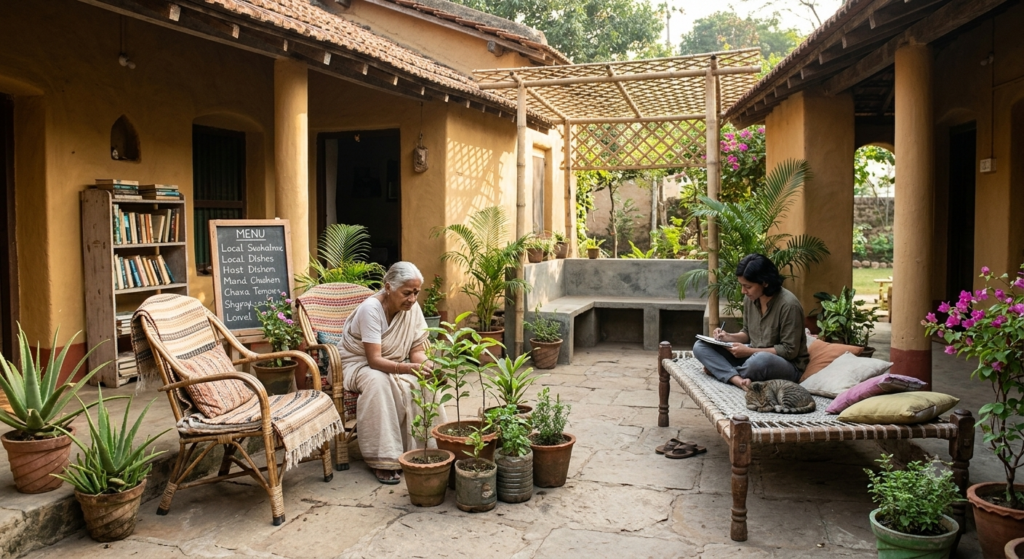
At the other end sits something different: a restored haveli with four or five beautifully done rooms, a coffee estate bungalow with its own veranda and cook, a Himalayan homestay built around a family’s own farm and kitchen. These are still homestays in the true sense, you’re staying with a family or a resident host rather than in an anonymous hotel, but they’re curated, considered, and often as design-led and comfortable as anything with “boutique” in the name.
That’s the category this article is really about: heritage and boutique homestays, where the personal, small-scale nature of a homestay is combined with the level of design, food and service you’d expect from a proper boutique hotel. It’s the best of both words, without needing to choose between them.
The Evidence: Why Homestay and Long-Stay Searches Are Overtaking the Checklist Trip
This is easy to dismiss as a trend piece cliché until you look at what’s actually being measured, in India and internationally.
Homestay and villa searches in India are climbing fast, and specifically. Booking data reported across Indian travel platforms in 2026, and corroborated by more than one source tracking the same figures, showed homestay and villa searches up 42 percent year-on-year, a sharp jump for a single travel season and a clear signal of where demand is actually moving.
Slow travel has moved from niche to mainstream in a single year. The European Travel Commission and Eurail’s Long-Haul Travel Barometer found the share of travellers identifying as slow travellers rose from 22 percent in 2025 to 26 percent in 2026.
Demand for restorative, unhurried trips is now the majority position, not the exception. Research from Expedia Group’s 2026 travel trends work, which includes Vrbo, found that 91 percent of travellers said they were interested in slower, simpler trips built around rest and meaningful experiences rather than packed sightseeing.
Quiet, low-key pursuits are increasingly the point of a trip, not filler around it. Booking.com’s 2026 Travel Predictions, drawn from nearly 29,000 travellers across 33 markets including India, found that a quarter of respondents said unhurried pursuits, birdwatching, forest bathing, or simply reading, were reason enough on their own to justify a trip.
Luxury travel advisors are seeing the same pattern at the top of the market. Virtuoso’s 2026 Luxe Report, drawn from more than 2,400 advisors across over 50 countries, found that high-end travellers are no longer satisfied with luxury for its own sake, and are prioritising journeys that feel personal and restorative over ones that simply look impressive.
India’s regional data tells the same story from another angle. Hospitality investment analysts covering India’s regional expansion for HICSA 2026 found that more than 38 percent of international visitors to India now venture beyond the metro gateway cities toward cultural, wellness and experiential destinations, the exact territory where homestays and heritage stays dominate, and that these travellers tend to spend more per trip than typical group or business visitors.
And hotel brands everywhere are building products around the same instinct. Hilton has named “hushpitality,” calm, quiet, deliberately unhurried stays, as one of its defining trends for 2026.
Taken together, this isn’t a handful of properties getting lucky with marketing. It’s a measurable reallocation of where travellers, from Jaipur to Jersey, are choosing to spend their time, money and attention, and homestays are one of the biggest beneficiaries of that shift.
Where the Shift Is Most Visible: Homestays and Heritage Stays Across India
This isn’t confined to Europe’s postcard regions. If anything, it’s currently most visible in India, where heritage and homestay hospitality have been building momentum for over three decades and are now accelerating fast.
Heritage Homestays in Rajasthan
Rajasthan remains the best known home of this kind of stay, largely because it got there first. Since the early 1990s, operators like Neemrana Hotels have been restoring forts and havelis into what they call “non-hotels,” properties that preserve original architecture rather than retrofitting it into a standard floor plan. Further east, BrijRama Palace in Varanasi, built in the early 1800s and sitting directly on the Ganges ghats, has been operating continuously for over two centuries, a useful reminder that “heritage” in India can mean something genuinely old, not just old-fashioned in style.
Coffee and Tea Estate Homestays in Coorg and Munnar
South India’s hill country has its own version of this: working coffee and tea estates that take a small number of guests into planter’s bungalows, often run by the same family for generations. A homestay in Coorg or Munnar isn’t a themed experience bolted onto a hotel, it’s a real working estate that happens to have a few rooms to spare, which is precisely what makes it feel earned rather than staged.
Backwater Homestays in Kerala
Alleppey and Kumarakom have built an entire model of tourism around family-run backwater homestays, from converted heritage houses to houseboats moored for the night, that let guests experience Kerala’s canal life directly rather than from a coach window.
Craft-Led Boutique Homestays in the Northeast and Ladakh
Further out, a newer wave of homestays across the Northeast and Ladakh is built around bamboo architecture, local craft and community-run tourism circuits, often directly supported by state tourism initiatives designed to keep the economic benefit local.
Beyond India
The same instinct shows up abroad in different architectural language: Umbria and Tuscany’s agriturismi and converted watermills, small estate lodges in the Scottish Highlands, Kyoto’s restored machiya townhouses and Japan’s ryokan tradition, and colonial-era tea planters’ bungalows in Sri Lanka’s central highlands, increasingly popular with travellers from India and further afield. Different countries, different centuries of architecture, the same underlying logic: the stay is doing more of the storytelling, and the itinerary is doing less.
Why Travellers Are Choosing the Homestay Over a Hotel
Checklist fatigue is real, and it’s exhausting people
For a couple of decades, a “good” trip meant an efficient one: maximum landmarks, minimum downtime. That stops working once people are travelling more often and simply want to arrive home rested rather than needing a holiday to recover from the holiday.
“I didn’t want a schedule. I wanted a week where nobody asked what we were doing next,” is close to a direct quote from more than one returning guest, whether they’ve just come back from a Kerala backwater homestay or a lodge in the Scottish Highlands.
A good homestay or heritage stay offers a way out of the checklist logic entirely. Staying in stops feeling like wasted opportunity, because the stay itself is already a considered, concentrated version of the place.
Intimacy has become the new marker of luxury
Twenty years ago, luxury was measured in scale: enormous lobbies, endless buffets, hundreds of rooms. That definition has quietly flipped. A five room heritage homestay where the host remembers how you take your coffee now reads as more luxurious than a three hundred room resort with a marble atrium, because scarcity and personal attention are harder to manufacture than square footage.
Design and story have become part of the itinerary, not the backdrop
Homestays and boutique heritage properties are increasingly built around a story: reclaimed materials, regional craftsmanship, hand block printed Rajasthani textiles on the bedside table, or a Coorg homestay’s own coffee roasted on site. Spending an afternoon in a space like that isn’t downtime. It’s the closest thing to a cultural experience the trip has to offer.
Flexible work has made longer, slower stays possible
A trip built around a single exceptional homestay tends to want more time, not less. The rise of remote and flexible work has made that practical, and India’s own workation boom is one of the clearest examples of this playing out at scale, with the average workation traveller now extending stays from two or three days to four to seven.
Homestay, Heritage Hotel or Boutique Resort: What’s Actually the Difference
Not every listing that calls itself a homestay or boutique property delivers the same experience. Here’s how the three tend to differ in practice.
| Signal | Heritage Homestay | Boutique Heritage Hotel | Standard Hotel or Resort |
| Who runs it | A family or resident host, often on-site | An independent owner or small operator, may not live on-site | A management company or chain |
| Scale | Usually 3 to 10 rooms | Typically under 30 rooms | Can be any size, including very large |
| Sense of place | Deeply personal, tied to one family’s history | Reflects the region through design and architecture | Interiors could belong almost anywhere |
| Food | Home-cooked, often eaten with the host’s family | Menu tied to local producers and season | Standardised hotel menu |
| Access to local life | Direct, through the host’s own network | Curated by an owner or local guide | Generic concierge desk or app |
None of these is automatically “better.” A homestay gives you proximity to a real family and their way of life. A boutique heritage hotel gives you more privacy and polish while keeping the same sense of place. The right choice depends on what the trip is actually for.
How to Choose and Book a Homestay or Boutique Stay You’ll Actually Remember
Start with the feeling, not the postcode. Decide what the trip is meant to deliver, rest, reconnection, celebration, quiet, before choosing a region. The right homestay in the “wrong” country will usually outperform the right country with the wrong stay.
Check who you’ll actually be staying with. For a true homestay, ask whether the host or family lives on-site, and how many other guests are typically hosted at once. This is the difference between an intimate stay and a listing that’s simply been labelled a homestay for search purposes.
Ask direct questions before booking. How many rooms does the property have. Who restored or built it, and why. Where does the kitchen source its ingredients. What’s included that you won’t find written into the rate, a shared family meal, a walk with the host, access to a private trail or estate.
Plan roughly half the trip and leave the rest unscripted. Book the essentials and leave real space for the homestay or property, and its host, to shape the rest.
Budget differently. A stay-led trip often costs more per night and less overall, because you’re not paying for constant movement between hotels, restaurants and paid attractions.
Homestay or Hotel Chain: Which Fits Your Trip
It’s worth being honest here rather than reflexively anti-corporate. Some large hotel groups have built genuinely excellent lifestyle and design-led sub-brands, and a well-run big property can still deliver a strong sense of place.
But consistency and character tend to pull in opposite directions. A standardised brand exists to guarantee the same experience in every city, which is precisely what makes it hard to also feel unmistakably tied to one specific place. A homestay or independent heritage property doesn’t have that constraint. It can be strange, specific and deeply local in a way a 400 room flagship generally can’t, because its entire appeal depends on being irreplaceable rather than replicable.
The practical takeaway: if predictability matters most for this particular trip, a large brand may be the right call. If the stay itself is meant to be the memory, a well-chosen homestay or boutique heritage property still has the edge.
A Word of Caution: Spotting a Genuine Homestay From a Listing With Good Photos
Not every property using this language has earned it. As homestay and heritage travel has grown, so has the number of listings borrowing the vocabulary, “authentic,” “immersive,” “family-run”, without much substance behind it.
A few honest tells: if there’s no real host presence and it’s actually run by a management company, if the “local experiences” on offer are identical to what every other listing in the region promises, or if reviews mention friendly staff but never mention an actual family or host by name, the “homestay” label is probably doing more work than the property itself.
Genuine homestays and heritage properties tend to be quietly confident rather than loudly marketed. The best ones rarely need to insist on it.
Frequently Asked Questions
Plan the Stay, Then Build the Trip Around It
If a homestay, heritage haveli or estate bungalow has caught your eye, in Rajasthan, Coorg, Kerala or somewhere further afield, and you’re not sure how to build the rest of the trip around it, that’s precisely the kind of planning we do at The Other Way. Tell us what drew you in, and we’ll help you shape a journey that earns its place around it.